Seedance 2.5 is a video model that renders 4 to 30 seconds as one continuous take, with the dialogue, room tone and lip sync generated in the same pass as the picture rather than dubbed on afterwards. That single property is why it works for UGC ads: a creator can open a jar, use the product and land a line without a cut hiding the moment where the packaging changes shape. In Pixair AI it is one of the two engines behind UGC Ads. You upload a product photo, pick a creator, write what they say, and get a 9:16 or 16:9 clip back at 480p, 720p or 1080p. A 10-second clip runs from 154 credits, about $6.93.
Seedance 2.5, 10 seconds, 720p, 9:16. One take: she opens it, uses it, names one result. The product, the voice and the mouth movements all come out of a single render.
What Is Seedance 2.5?
Seedance 2.5 is ByteDance's video generation model. For advertising work, four of its properties matter more than anything on a benchmark chart:
- •Length. 4 to 30 seconds natively, rendered as a single unbroken shot. Most competing models cap at 8 or 10 seconds and expect you to stitch.
- •Joint audio. Speech and picture are generated together, so the mouth matches the words because both came from the same forward pass. Nothing is re-synced.
- •Reference conditioning. It takes your product photo as a reference to build the scene around, not as a first frame to animate. The pack keeps its shape, colour and label wording while everything else is invented.
- •Timecoded direction. It reads second-level timestamps in the prompt, so you can say what happens between 0s and 3s and expect it to land roughly there.
Output lands at 24 frames a second. A 9:16 clip at 720p comes back exactly 720 x 1280, which is native for Reels, TikTok and Shorts and needs no re-encode before it goes into Ads Manager.
How Much Does a Seedance 2.5 UGC Ad Cost?
Seedance bills by the second and by resolution, which nobody publishes as a dollar figure. Here is the full grid, in credits and in real money at the annual plan rate of $0.045 per credit. This is the table to read before you queue ten variations.
| Clip length | 480p | 720p | 1080p |
|---|---|---|---|
| Per second | 15.4 cr / $0.69 | 33.1 cr / $1.49 | 79.6 cr / $3.58 |
| 5 seconds | 77 cr / $3.47 | 166 cr / $7.47 | 398 cr / $17.91 |
| 10 seconds | 154 cr / $6.93 | 331 cr / $14.90 | 796 cr / $35.82 |
| 15 seconds | 231 cr / $10.40 | 497 cr / $22.37 | 1,194 cr / $53.73 |
The workflow that grid implies is the one that actually saves money: draft at 480p, publish the winner at 720p or 1080p. A 5-second 480p test costs 77 credits, so a Pro month at 400 credits buys five hook tests with room to spare. Rendering those same five at 1080p first would cost 1,990 credits and tell you nothing extra, because a hook either stops the thumb at 480p or it never will.
1080p is a finishing resolution. Spend it once, on the cut that already beat the others, and only when the placement rewards the sharpness. On a Reels feed viewed on a phone at 60% brightness, the gap between 720p and 1080p is worth far less than the $20.92 it costs.
Is Seedance 2.5 Cheaper Than Hiring a UGC Creator?
A real creator is still better at the things a model cannot fake: an actual opinion, a face your audience recognises, a niche accent. What they cannot do is turn around eight hook variants on a Tuesday afternoon. The comparison that matters for performance creative is not quality per clip, it is clips per week per dollar.
Hiring a UGC creator
Brief, ship product, wait, review

Seedance 2.5 in Pixair
Hiring a UGC creator
Brief, ship product, wait, review
Seedance 2.5 in Pixair
Cost per finished clip
$150 - $500
$3.47 - $35.82
Turnaround
7 - 21 days
A few minutes
Product sample needed
Yes, shipped
No, one photo
Cost of a reshoot
Full rate again
The clip price again
Hook variants per day
1 - 2
As many as credits allow
Usage rights
Negotiated, often 30 - 90 days
Yours, no expiry
Genuine lived opinion
Yes
No, it is a performance
Read the last row honestly. Seedance 2.5 gives you a performance, not a testimonial, and the fastest way to burn an account is to run a synthetic clip as if a real customer filmed it. Use it for the job it is actually good at: finding which hook, which staging and which first three seconds move the metric, so that when you do pay a real creator, you are paying them to perform a script you already know works.
Why Does One Continuous Take Change How You Write a UGC Ad?
Every UGC script written for a human assumes an editor. You film the unboxing, you film the reaction, you cut between them, and the cut quietly repairs every continuity problem in between. Seedance 2.5 has no cut to hide behind. Whatever you write happens in real time, in one shot, in front of the lens.
Three writing habits break immediately:
Big motion. A long take resolves fast movement badly. Sprinting, lunging, a bottle thrown and caught, anything that would have needed a cut to look good, comes back smeared. One physical movement per beat, carried all the way through before the next one starts.
Effects without causes. If she looks down at a spill, the elbow has to hit the cup in an earlier beat. Written the other way round, the model invents a cause, and the cause it invents is usually a second pair of hands.
State that runs backwards. A sealed jar cannot be open at 6s unless something opened it on camera at 4s. If the bite is taken, the crumbs stay. Product state only ever moves one way through a single take, and the most common broken render is the sealed pack that is simply open by the time it reaches her mouth.
There is a matching rule for length. Under about 20 seconds a single take fills itself with one small story. Past that it needs real narrative, or you get a person talking into a lens with nothing happening. If your 30-second script is only 12 seconds of content, render 12 seconds and put the budget into a second hook instead.
Does Seedance 2.5 Generate Its Own Audio and Lip Sync?
Yes, and this is the reason the sync holds. Speech is generated jointly with the picture instead of being produced separately and aligned afterwards, so there is no drift to correct. The practical consequence is that voice direction is not decoration in the prompt, it is the only control you have over how the line sounds. Written lines are delivered word for word, so the words you type are the words you hear.
The hard constraint is timing. Conversational delivery lands at 2.6 to 2.9 words per second, and a written pause costs roughly three words of runtime. That gives you a usable script budget:
| Clip length | Spoken words | Timeline beats |
|---|---|---|
| 5 seconds | 13 - 15 | 2 |
| 10 seconds | 26 - 29 | 2 - 3 |
| 15 seconds | 39 - 44 | 3 - 4 |
| 30 seconds | 78 - 87 | 6 - 8 |
Overwrite that budget and the model speeds the delivery up to fit, which is exactly the tell that makes a clip read as synthetic. Thirty seconds is not a lot of room: 87 words is roughly a short paragraph. Count the words before you count on the length.
What Do Seedance 2.5 UGC Ads Actually Look Like?
All three below are 10-second 720p renders in 9:16, each built from one product photo and a three-beat outline. Nothing was edited afterwards - the audio, the room tone and the framing are as they came out.
Caught mid-errand. The hook is a hand reaching, not a greeting.
Walk and talk. A near-fumble opens it, then one feature, then a flat sign-off.
Seated testimonial. Real friction opening the pack, then the numbers.
Notice what all three open on: a physical event, never a claim. A hand reaching, a near-drop, a pack being fought open. That is not a stylistic preference, it is the format working with the model instead of against it - a long take has nowhere to put a talking-head introduction, and the first three seconds are the only ones most viewers will see anyway. There is more on that structure in our guide to turning a product photo into a video ad.
How Do You Prompt Seedance 2.5 for a UGC Ad?
A one-line prompt gets you a one-line result. What Seedance 2.5 responds to is a structured brief that pins down the things a single take can get wrong. In Pixair this is assembled for you from the creator, the photo and the script, but the structure is worth knowing whether you use it here or elsewhere.
Send the product as a reference, not a first frame
Seedance 2.5 rejects source images carrying a real person's likeness, so you cannot hand it a photo of a creator holding your product and ask it to animate that. The working pattern is the opposite: the product photo goes in as a visual reference, the creator is described in text, and the model casts the person and builds the scene around the pack. That is also why it accepts a real aspect ratio instead of inheriting the shape of a source image.
Use second-level timestamps, not bracketed ranges
The timeline format it reads is 0s-3s: followed by what happens. Bracketed ranges of the [0-3s] kind that other video models expect are read as decoration here. Give the spoken line its own timestamp too, so the words are pinned to the same block as the action they belong to.
Budget the hands before you write the beats
A creator filming themselves has one free hand, because the other one is holding the phone. Twisting a lid, tearing a wrapper, peeling a seal and pouring all need two. Ask for a two-handed action while the phone is handheld and the model resolves it the only way it can, by floating the product in mid-air with a disembodied hand working at it. Decide first whether the phone is handheld or propped on a surface, then write only beats that fit inside that choice.
Never turn the product unless the script needs it
Rotation is the single biggest risk to your label. Every turn forces the renderer to redraw the lettering at a new angle, and it comes back mirrored, warped or spelling something else. Keep the front label square to the lens, in one grip, for the whole take. Only turn it when she genuinely has to read something off the back, and then turn it once, slowly, and bring the front back to camera afterwards.
Close the loop on the ending state
State where the creator, the product and the camera are at the final second, and that the last word has already landed. Without it, long takes drift: the clip ends mid-syllable, or cuts to a packshot the model decided to add. Say explicitly that it ends on the person, not on the product.
Assembled, that brief runs to nine labelled blocks - format, cast, starting state, timeline, camera, continuity, audio, ending state and constraints - and several thousand characters. It reads like a shot list because that is what it is. If you would rather not write one, the creator picker, the outline assist and the brief assembly all live inside the ad creative maker.
Should You Use Seedance 2.5 or the 10-Second Engine?
UGC Ads in Pixair ships two engines and they are not interchangeable. The default is tuned for value and caps at 10 seconds. Seedance 2.5 costs roughly 3.4 times as much per clip and buys you length, a resolution control, and noticeably tighter motion and sync.
The default engine, same format: parcel opened on camera, one honest reaction, one line about who it is for.
A simple rule works most of the time. Use the default engine while you are testing hooks - a hook lives or dies in the first three seconds, and paying a premium to render the seven seconds after it is money spent on a question you have not asked yet. Switch to Seedance 2.5 once a hook wins and you need the version that carries a full demonstration, a claim and a call to action without cutting.
The other reason to reach for Seedance 2.5 is a product whose whole story is a sequence: something that opens, transforms, pours or gets applied. Ten seconds is enough to show one of those steps. Twenty is enough to show the sequence, and a sequence shown in one unbroken shot is the most persuasive thing a synthetic clip can do, because a cut is exactly where a sceptical viewer assumes the trick was.
Five Things That Break a Seedance 2.5 UGC Ad
A product photo shot at an angle
The reference decides how the pack is rendered for the whole take. A three-quarter product shot gives the model an ambiguous read of the label, and ambiguity in the reference becomes invented lettering in the video. Feed it a square-on shot of the front face, lit evenly, with the full label readable.
An opening line instead of an opening event
“Hey guys, so I have been using this for two weeks” spends the three seconds that decide the ad on nothing. Open on the lid coming off, the first taste, the near-spill, the parcel being cut open. The event has to belong to the product itself or to what came with it - its box, its mailer, its wrapper - and not to some unrelated object that happens to be on the desk.
A script written to the second-count, not the word-count
Writers estimate 30 seconds and produce 120 words. Seedance will deliver all 120 in 30 seconds, at a pace no human uses, and the clip reads as fake before anyone consciously works out why. Trim to 87 words for a 30-second take and let the silence do some work.
Testing at the resolution you plan to ship
Five 1080p hook tests cost 1,990 credits. The same five at 480p cost 385 and answer the identical question. Every advertiser who overspends on this model does it the same way: by treating the resolution picker as a quality setting rather than a stage of the funnel.
Reusing a script that sold something else
Lines you type are spoken word for word, which means a script lifted from a winning ad for a different product will have your creator enthusiastically describing the wrong thing. Keep the structure - the hook shape, the beat order, the length of the payoff - and rewrite the nouns for what is actually in the photo. That is the same discipline behind good AI ad testing workflows.


Frequently Asked Questions
Seedance 2.5 is a ByteDance video generation model that renders 4 to 30 seconds as one continuous take, with speech, room tone and lip sync generated in the same pass as the picture rather than dubbed on afterwards. It outputs at 24 frames a second in 9:16 or 16:9 at 480p, 720p or 1080p. For advertising it is used to turn a product photo plus a written script into a creator-style clip where the real pack, label and colours stay on screen throughout.
Up to 30 seconds, rendered as a single unbroken shot with no cuts. That is roughly three times the ceiling of most competing video models, which stop at 8 or 10 seconds. In practice anything past about 20 seconds needs a real narrative to fill it, so a 30-second render is worth paying for only when the script genuinely has 78 to 87 words of content and a sequence to show.
In Pixair a Seedance 2.5 clip is billed per second by resolution: 15.4 credits a second at 480p, 33.1 at 720p and 79.6 at 1080p. At the annual plan rate of $0.045 per credit, a 10-second clip costs $6.93 at 480p, $14.90 at 720p and $35.82 at 1080p. Drafting hooks at 480p and rendering only the winner at 720p or 1080p typically cuts a testing cycle to a fifth of its cost.
Yes. Speech is generated jointly with the picture in a single pass, which is why the mouth matches the words without a separate sync step. Written lines are delivered verbatim, so the script you type is what you hear. Budget 2.6 to 2.9 words per second of clip - about 29 words for 10 seconds - because an overlong script is delivered faster rather than trimmed, and the rushed pace is the clearest tell that a clip is synthetic.
No. Seedance 2.5 rejects source images that carry the likeness of a real person, so you cannot upload a photo of a creator holding your product and animate it. The working pattern is the reverse: the product photo goes in as a visual reference, the creator is described in text, and the model casts the person and builds the scene around your pack. If you need to animate an existing shot of a person, use the default 10-second engine instead.
The honest summary: Seedance 2.5 is the expensive engine, and it earns that price on exactly two jobs - length and unbroken sequences. Test cheap, finish here. Start free with 30 credits to generate your creator and a first static ad, or read how the same product photo becomes a UGC ad without hiring an actor before you pick an engine.
Keep reading
Related articles
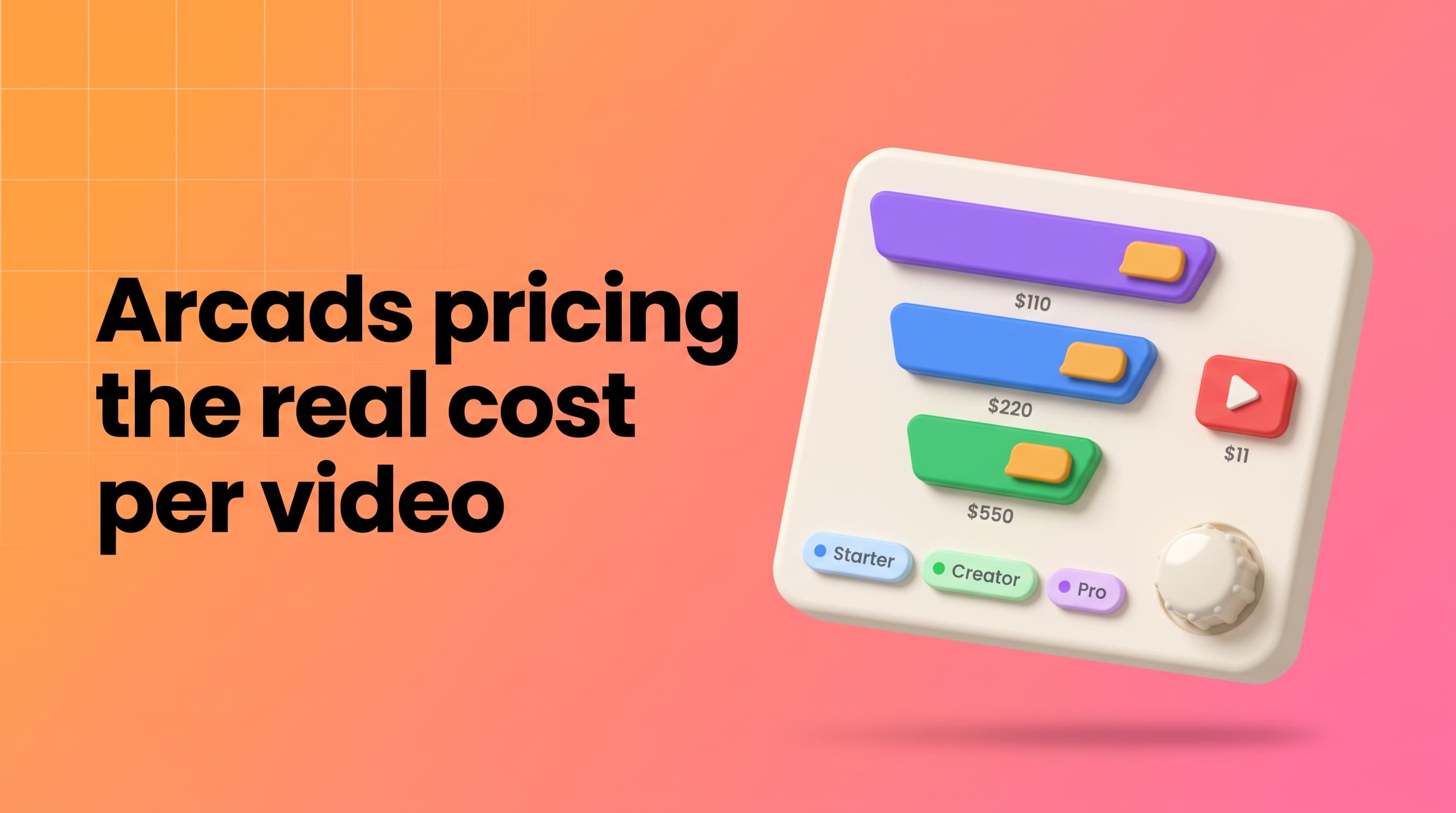
Arcads AI Pricing 2026: Complete Cost Per Video Guide
Arcads AI pricing is $110, $220 or $550 a month at 800 credits per actor-minute, with no public price page. See the real cost per video and cheaper options.
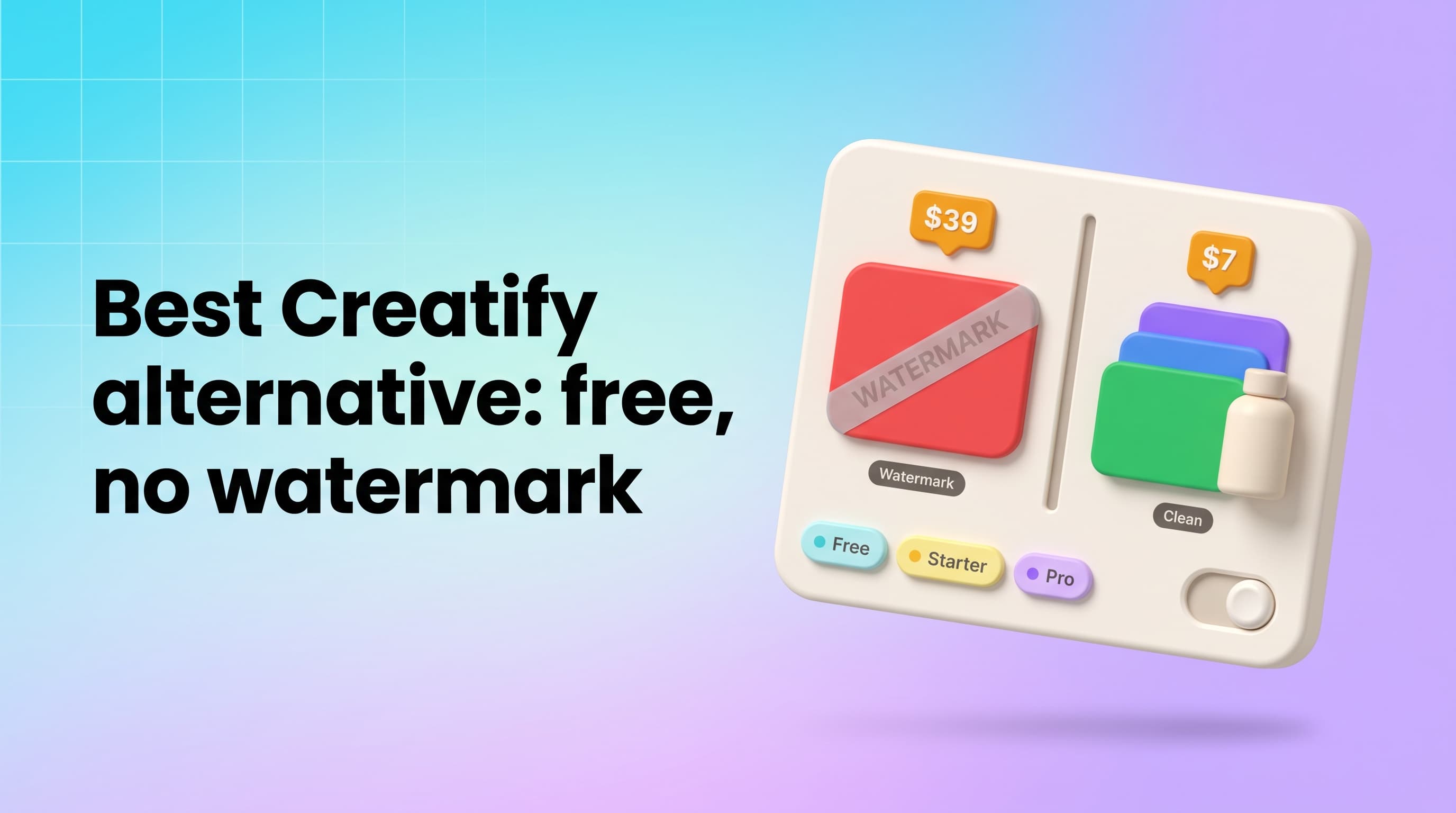
Best Creatify Alternative 2026: Free, No Watermark, From $7
Creatify starts at $39/month and watermarks every free video. This Creatify alternative gives 30 free credits with no watermark, then plans from $7/month.

Best MakeUGC Alternative 2026: UGC Ads Without the $1 Trial
MakeUGC costs $59-$149/month, the $1 trial auto-renews after 72 hours and unused credits expire monthly. This MakeUGC alternative makes UGC ads from $4.41.