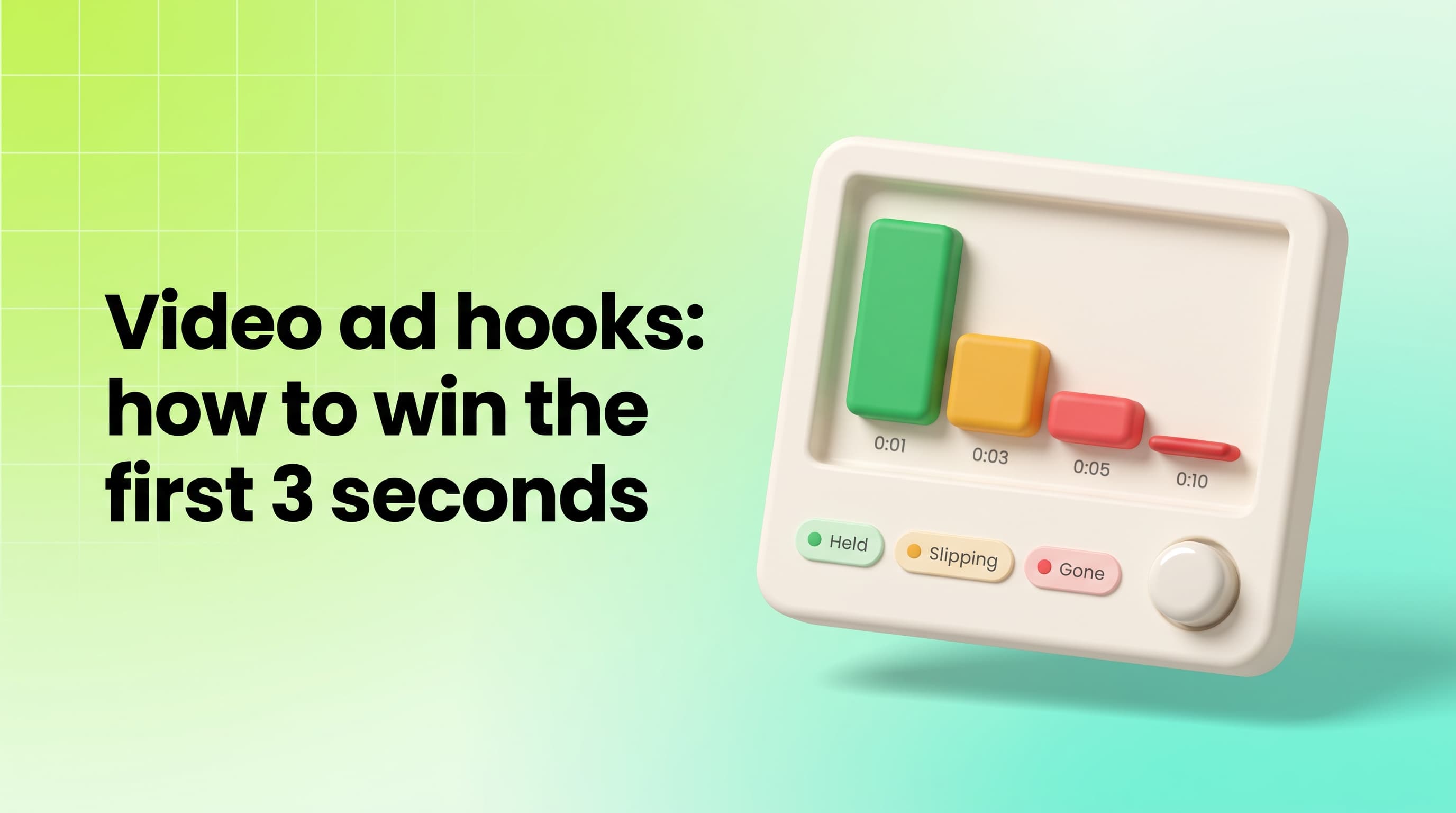
Video ad hooks are the first one to three seconds of a video ad, and they decide whether the rest of the ad is ever seen. A hook is not an introduction. It is the trade you make with a viewer who has already decided to scroll: give them a reason to stay for one more second, then another. Six mechanisms do almost all the work in practice - the open loop, the pattern interrupt, the negation, costly honesty, odd specificity, and starting mid-story. In Pixair AI each one exists as a ready-made hook you can drop into a script and render with your own product, so testing five of them costs $11.05 instead of a week and a creator invoice.
A negation hook. It removes the explanation the viewer already had, then leaves a hole only the ad can fill.
What Is a Video Ad Hook?
A video ad hook is the opening beat that buys attention before the ad has earned any. On a feed, not watching is free. It costs the viewer nothing, requires no decision, and happens with a thumb flick they have already performed several hundred times that day. Your video does not open with an audience. It opens at zero.
That reframes what the first line is for. It is not there to introduce the brand, set up context, or be polite. It is there to make stopping feel more interesting than scrolling, and it has about three seconds to do it. Everything after that point is a reward the ad has not been granted yet.
This is why hooks behave differently from the rest of the creative. A headline can be optimised. A hook has to be won, against a default behaviour that costs the viewer nothing.
Why Do Hooks Decide Your CPM, Not Just Your View Count?
Ad platforms do not rank creative by how good it is. They rank by evidence, and the first evidence a video produces is whether people stayed. Meta reports 3-second video plays and ThruPlays. TikTok reports retention curves and completion rate. Those numbers are not a scoreboard you read after the fact - they are inputs that decide how far the platform pushes the ad and what it charges you per thousand impressions.
So the hook is not really a creative decision. It is a distribution lever. Run the same product, the same offer, the same landing page and the same budget, change only the first eight words, and the CPM moves. A video that holds people is cheap for the platform to serve, so it serves more of it. A weak opener means paying full price for every impression while the actual product argument sits at second twelve, where nobody arrives.
This is also the mechanism behind the most common false negative in creative A/B testing. An ad gets killed for poor ROAS when the body was never the problem - the hook lost the audience before the offer was spoken, and the test measured nothing except the first line.
What Are the Six Hook Mechanisms That Actually Work?
Almost every hook that holds attention is running one of six plays. The surface wording changes per product and per audience, but the underlying mechanism does not, which is what makes them testable.
The open loop
Start a sentence the viewer's brain is obliged to finish. “Nobody warned me this happens after every shower.” Happens what? The viewer is now watching to close the loop, which is not persuasion so much as an itch. Open loops are the most portable of the six because every product solves a problem somebody did not see coming.
The pattern interrupt
A feed has a shape - bright, loud, polished, someone greeting you. Anything shaped differently gets a free beat of attention. Three seconds of a face saying nothing, in a feed where everything talks, reads as louder than talking. The wordless hook has no line at all, only a direction: hold a reaction straight down the lens and let the face carry it.
The negation
“It's not the salary.” “It's not your content.” You take away the explanation already sitting in the viewer's head. Now there is a hole where their reasoning used to be, and only the ad can fill it. Negation works best when the assumption you remove is the one your whole category keeps repeating.
Costly honesty
“Eleven years doing this, and I still wreck one in three.” An insider admitting a flaw buys credibility no claim can buy, because it is information that costs them something to say. Nobody lies in that direction, and viewers know it. This is the highest trust-per-second hook available, and the one most brands refuse to use.
Odd specificity
“I asked forty people this question today. Two got it right.” Not “most people don't know this”. Forty and two sound observed; most and many sound marketed. Precision reads as true even when nobody verifies it - which is exactly why the number in your hook has to be a real one from your own business, not a statistic borrowed to sound authoritative.
Starting mid-story
“I came in here for a coat and somehow I'm holding these.” The story is already moving and the viewer joined late. Late is compelling. The beginning is skippable. This one suits impulse and discovery products, where the honest purchase story genuinely was an accident.
Four of them, said out loud
A hook that reads well and a hook that plays well are different objects. These are the same mechanisms delivered on camera, which is the only form in which they can be judged.
What Does It Cost to Test Five Hooks?
This is the number that changes how you work. The correct unit of creative testing is not one ad - it is one body with five different hooks in front of it. Five ads, one idea, five answers to the only question that decides the campaign. What stops most teams doing it is the assumption that five variants means five shoots.
A UGC clip in Pixair costs 49 credits at 5 seconds and 98 credits at 10 seconds, which is $2.21 and $4.41 at the annual plan rate of $0.045 per credit. Hook drafts do not need to be full length - a 5-second render is enough to judge whether a line lands. That produces the following:
| Hooks tested | 5s drafts | Full 10s clips | Briefed to creators |
|---|---|---|---|
| 1 | $2.21 | $4.41 | $150 - $350 |
| 3 | $6.63 | $13.23 | $450 - $1,050 |
| 5 | $11.05 | $22.05 | $750 - $1,750 |
| 10 | $22.10 | $44.10 | $1,500 - $3,500 |
Creator column assumes a standard $150 - $350 per-video rate for a briefed UGC clip, one creator per variant.
At $11.05 a round, hook testing stops being a budget line and becomes a habit. The wider difference is not price though - it is that every variant keeps the same creator, the same product and the same framing, so the hook is the only thing that changed. That is the condition a clean test requires and the one a multi-creator shoot can never meet.
Briefing hook variants to creators
Casting, briefs, revision rounds

Pixair AI
Briefing hook variants to creators
Casting, briefs, revision rounds
Pixair AI
Cost per hook variant
$150 - $350
$2.21 at 5s
Turnaround per round
5 - 14 days
Under 5 minutes
Variants per round
1 - 2 realistically
As many as you write
Creator held constant
New casting each time
Same creator every variant
Changing one line
Full reshoot
Edit the script, rerun
Product on camera
You ship samples first
Your product photo
How Do You Write and Test Hooks in Pixair?
The hook shelf sits inside UGC Ads. Each hook is a real clip you can watch before committing to it, and clicking one writes its line straight into the script.
Pick the mechanism before the words
Choose which of the six plays fits your product, then write to it. Writing first and classifying afterwards produces five versions of the same hook wearing different clothes, which is the most common way a hook test returns no signal.
Write it to be said, not read
A 5-second clip carries roughly 13 to 15 spoken words, so the hook has to land inside about eight of them. Say the line out loud before you render it. Anything you stumble over, a creator will stumble over too, and stumbles read as scripted.
Hold everything else constant
Same creator, same product photo, same framing, same length. Upload your product once and swap only the opening line between renders. If two things changed, the round tells you nothing about either.
Judge on hold rate, then rebuild the winner
Read 3-second plays against impressions, not likes. Once one hook separates from the pack, render it at full length with the real payoff behind it - that is the ad that goes into rotation, and the other four are now a library of shapes you know your audience rejects.
The same discipline applies to the rest of the creative once the hook is settled. If you are building a repeatable cycle rather than a one-off round, the creative testing engine guide covers how the winners feed back into the next batch, and turning a product photo into a video ad covers the four formats a hook can sit in front of.
Five Mistakes That Kill a Hook Before Second Two
Putting the brand name in the first line. You spent the only three seconds you had introducing yourself to somebody who did not ask. The product enters after the attention is bought, never before.
Announcing the hook. “Let me tell you why” is a receipt that reads: this is an ad. The line has to arrive as though the viewer walked in on a conversation already in progress.
Overpromising past the payoff. A bait hook wins the 3-second play and then dies at second five. That is worse than a weak hook, because the platform learns the video loses people and quietly stops serving it. You do not just lose that viewer, you lose the next thousand.
Running one mechanism across the whole account. Audiences habituate to a shape faster than to a message. Five open loops in a row stop being open loops. Rotate the mechanism, not just the wording.
Grading hooks on engagement. Likes and comments measure how the ad ended. Hooks are graded on whether second four happened at all, which is a different metric on a different part of the curve.


Frequently Asked Questions
A video ad hook is the first one to three seconds of a video ad, written specifically to stop a scroll before the ad has earned any attention. It is not an introduction to the brand or the product - it is a trade that gives the viewer a reason to stay for one more second. Six mechanisms cover most working hooks: the open loop, the pattern interrupt, the negation, costly honesty, odd specificity, and starting mid-story.
One to three seconds, which is roughly eight spoken words. A 5-second UGC clip carries about 13 to 15 words in total, so the hook has to land in the first half of it and leave room for the payoff. Anything longer than three seconds is no longer a hook, it is the body of the ad, and by then the audience has already been decided.
Yes, indirectly but reliably. Meta reports 3-second video plays and ThruPlays, and TikTok reports retention curves - these feed the delivery system that decides how widely an ad is served and what it costs per thousand impressions. A video people stay on is cheaper for the platform to serve, so identical creative with a stronger opening line typically earns cheaper distribution than the same ad with a weak one.
Five per body is the practical unit, each running a different mechanism rather than five rewordings of the same idea. Keep the creator, product photo, framing and clip length identical across all five so the hook is the only variable. In Pixair five 5-second hook drafts cost 245 credits, which is $11.05 at the annual rate of $0.045 per credit.
A UGC clip in Pixair is 49 credits at 5 seconds and 98 credits at 10 seconds, which is $2.21 and $4.41 respectively at $0.045 per credit on an annual plan. Testing five hooks as short drafts costs $11.05 and ten costs $22.10, against roughly $150 to $350 per video for a briefed UGC creator. New accounts get 30 free credits with no card required.
Hooks are the cheapest variable in the entire funnel. Reshooting an ad costs days; rewriting eight words at the front costs almost nothing. If you are already producing creator-style video, the longer-form UGC guide covers what to put behind the hook once one wins. Start with 30 free credits and put five openings in front of the same offer this week.
Keep reading
Related articles
UGC Ad Creatives With AI: The Complete 2026 Guide
UGC ad creatives cost $3.15 per 10-second clip when AI renders them from your product photo, not $200 per creator video. Hooks, examples, full workflow.
How to Turn a Product Photo Into a Video Ad (2026)
Four ways to turn a product photo into a video ad - animated, scene, explainer and UGC. See what each costs (from $1.89 per clip) and which to run first.
AI Ad Creative A/B Testing: How to Test Variations Fast
AI ad creative A/B testing framework for DTC: isolate one variable, hit 3,000 impressions per cell, and generate 8 clean test variations in under 30 minutes.