Updated Oct 2026
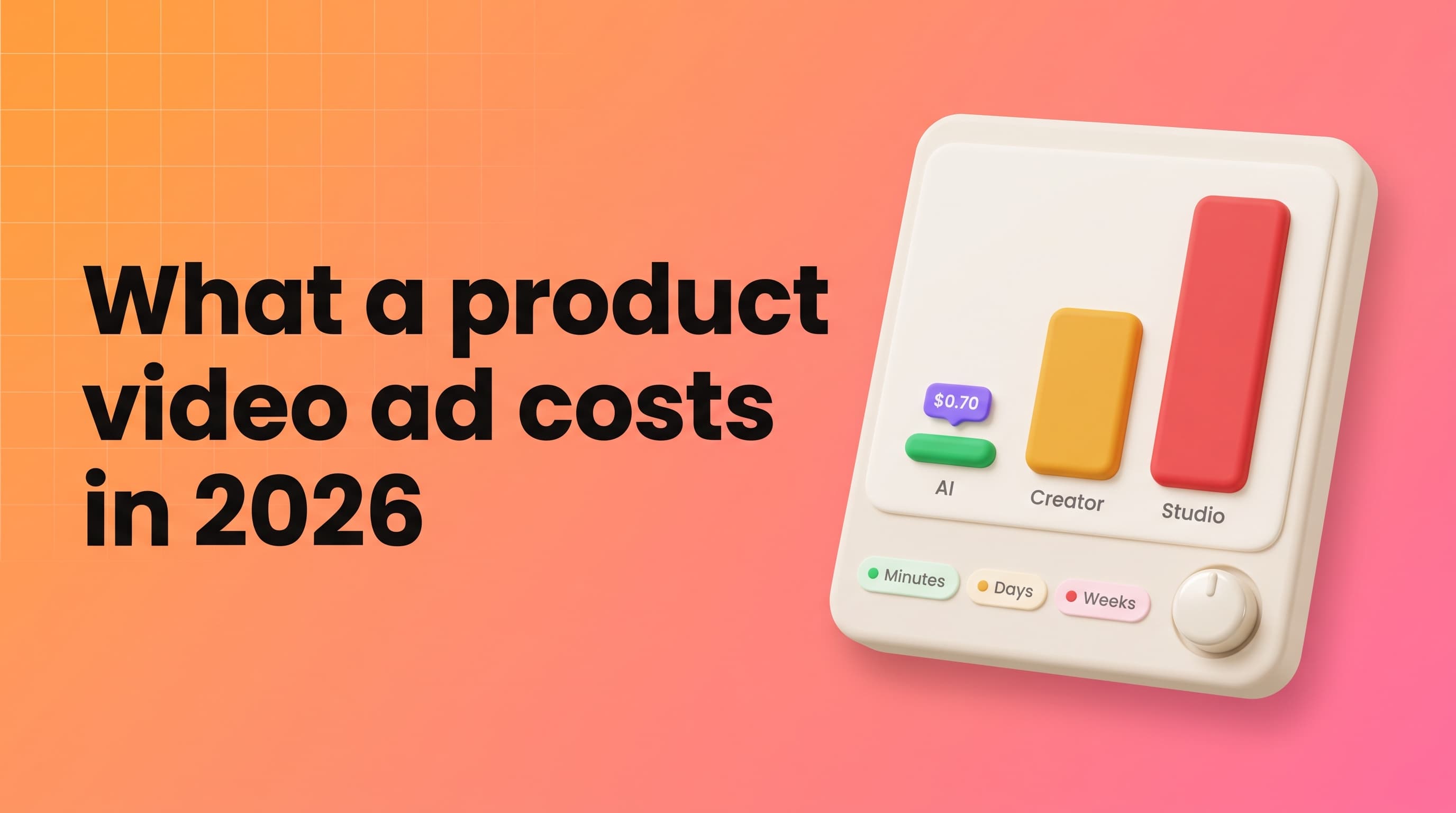
A product video ad costs $0.70 to $7.35 with an AI tool, about $175 per video from a UGC creator before you pay for ad usage rights, and $1,000 to $10,000 from a studio or agency. In Pixair, 5 seconds at 360p is $0.70, 10 seconds at 720p is $4.90 and 10 seconds at 1080p is $7.35. The gap gets wider once you count hook variations, usage rights and revisions, which is where most video ad budgets actually go.
Below are the real 2026 product video ad costs for all three routes, the fees each one leaves off the quote, and the total cost of finding one winning ad. AI prices come from Pixair AI's live credit pricing. Creator and studio prices come from published 2026 rate guides, linked in the sources at the end.
How much does a product video ad cost?
The quick comparison, per finished video, for a short vertical ad you would run on Meta or TikTok:
| AI video (Pixair) | UGC creator | Studio or agency | |
|---|---|---|---|
| Cost per video | $0.70 - $7.35 | $175 median ($150 - $300) | $1,000 - $10,000 |
| Rights to run it as an ad | Included | +30 - 50% of the base rate | Usually in the contract |
| Each extra hook | $0.70 at 5s 360p | About $50 | Billed as a revision round, $500 - $2,000 |
| Turnaround | Minutes | Days to weeks, plus shipping a sample | Typically 1 - 3 weeks |
| Packaging changes | Upload a new photo and re-render | New video, new fee | Re-shoot, $2,000 - $5,000 |
AI at the Starter rate ($0.07/credit). Creator rates: Influee 2026 UGC rate guide. Studio rates: Vidico (June 2026) and Bambuser 2026 guides. Checked Oct 2026.
How much does an AI product video ad cost?
AI video is billed per second, and resolution sets the rate. In Pixair UGC Ads you upload one product photo, pick an AI creator and give it a script, and the price covers the whole render: the creator holding your product, the voice and the lip-sync. Here is what each common length costs on three plan rates:
| Video | Credits | Starter ($0.07) | Pro monthly ($0.06) | Yearly ($0.05) |
|---|---|---|---|---|
| 5s 360p | 10 | $0.70 | $0.60 | $0.45 |
| 10s 360p | 20 | $1.40 | $1.20 | $0.90 |
| 10s 720p | 70 | $4.90 | $4.20 | $3.15 |
| 10s 1080p | 105 | $7.35 | $6.30 | $4.73 |
| 30s 720p | 210 | $14.70 | $12.60 | $9.45 |
Rate per credit = plan price / plan credits. Starter is $7 for 100 credits, Pro is $24 for 400 (or $18 billed yearly). Checked Oct 2026.
Two things decide your bill. Length is linear, so 10 seconds costs exactly twice 5 seconds. Resolution is not: 720p costs 3.5 times as much per second as 360p, and 1080p costs 5.25 times as much. That is why 360p exists - it is a draft setting for checking whether a script and hook land, not a setting to publish at.
Burned-in captions are the only common add-on, at 9 credits per started minute of video ($0.63 for any clip under a minute). For the full walkthrough of making one, see how to turn one product photo into a UGC video ad.
How much does a UGC creator charge per video?
The median UGC creator rate in 2026 is $175 per video, with most creators charging $150 to $300. That buys the video for organic use only. Running it as a paid ad adds 30-50% of the base rate for usage rights, so an ad-ready UGC video costs about $230 to $265 before any variations.
The base rate is the smallest part of most UGC invoices. According to Influee's 2026 UGC rate guide, these add-ons are standard:
- Usage rights for paid ads: 30-50% of the base rate. Without them, you cannot legally put the video behind ad spend.
- Hook or CTA variations: about $50 each. Testing five openings on one video adds $200.
- Whitelisting or Spark Ads: about 30% of the base rate per month, to run the ad from the creator's own account.
- Raw footage: 30-50% of the base rate, if you want to re-edit it yourself.
- Rush delivery: 25-50% on top.
Rights alone put the real cost per usable UGC ad at 1.3 to 1.5 times the quoted rate, before the product you ship to the creator and rarely get back. Bundles help a little: Influee reports 15-25% off for five or more videos.
How much does a studio or agency product video cost?
A studio-made ecommerce product video costs $1,000 to $3,000 at the budget end, $3,000 to $7,000 mid-range, and $7,000 to $10,000 or more for premium work, per Vidico's June 2026 pricing guide. A freelance videographer lands at $500 to $2,000 per video, and agencies quote $3,000 to $15,000 per project. Bambuser's 2026 guide puts studio product videos at $2,000 to $10,000 per SKU.
That money buys controlled lighting, macro detail, a crew and an editor. It does not buy volume. A studio delivers one polished cut, and every extra version - a new hook, a 9:16 crop, a localized voiceover - is a change order. For a single brand film that is fine. For paid social, where a winning ad usually fatigues in weeks, it means paying studio rates for every refresh.
What does it cost to find one winning video ad?
Per-video prices miss how video ads are actually bought. Most hooks fail, so the useful number is what it costs to test 10 openings and finish the one that works. Here is that test priced three ways:
| Route | What you buy | Total |
|---|---|---|
| AI (Pixair) | 10 drafts at 5s 360p (100 credits), then the winner at 10s 1080p (105 credits) | $14.35 |
| UGC creator | One video at $175, 9 extra hooks at $50, paid-ad rights at 30-50% | $677.50 - $712.50 |
| Studio | One budget product video, plus one extra revision round for alternate openings | $1,500.00 - $5,000.00 |
AI total at the Starter rate; 205 credits fits inside one $24 Pro month. Studio row assumes all alternate hooks fit in a single revision round, which is optimistic.
The AI route is about 47 times cheaper than the creator route and over 100 times cheaper than the studio, and it is the only one where testing more hooks is close to free. That changes how you test: instead of betting on one concept, you can run the structured split tests described in our ad creative A/B testing guide.
Which hidden costs change the total?
Every route has costs that do not appear on the first quote. These are the ones that move the number most.
UGC: rights that expire
Usage rights are often sold for a fixed window, such as 30 or 90 days. If the ad is still winning when the window closes, you pay again to keep running it. Ask for the term in writing before you scale spend behind a creator video.
Studio: every change is a change order
Vidico lists revision rounds beyond the included one or two at $500 to $2,000 each, reformatting for another platform at $200 to $500, localization at $600 to $2,000 per language, and a re-shoot after a packaging update at $2,000 to $5,000. These typically add 15-30% to the quoted price.
AI: re-renders and the plan you need
A render where a word on the label comes back wrong costs the same as one that works, so budget for some re-runs. A sharp source photo with a readable label cuts that down more than anything else. Video also needs a paid plan: the 30 free signup credits only cover the image tools.
All three: platform fees on top
Some all-in-one ad tools charge a share of your ad spend on top of the subscription. Zeely, for example, takes 12% of Meta spend launched through it. The Zeely cost calculator shows what that fee adds at your budget, and the Arcads pricing breakdown covers a per-video model.
How do you keep AI video ad costs down?
Draft every hook at 5 seconds and 360p
At $0.70 per draft, you are paying to judge the opening line, not the picture. The first two seconds decide whether the ad gets watched, so that is all a draft has to prove. Our video ad hooks guide has openings worth testing.
Keep one benefit per video
A 10-second ad has room for one claim. Three benefits in one script means a longer, pricier clip that tests nothing cleanly. Make three short videos instead and let the results pick.
Re-render only the winners at 720p or 1080p
Pick 720p for most feeds and 1080p when small label text has to stay sharp. Paying $7.35 for a 1080p video only makes sense once the hook has earned it.
Switch to yearly billing once you make video every week
Yearly Pro drops the credit from $0.07 to $0.05, a 36% cut on every render: the same 400 credits cost $18 a month instead of $24. Once video is a weekly habit rather than a one-off test, that cut applies to every draft and every finished ad.
When is a UGC creator or studio worth the money?
AI wins on cost per test, but it is not the right buy for every video:
- Hire a creator for genuine testimonials. When the ad is a real customer describing real results, it has to be a real person who used the product. An AI creator can present your product, but it should not claim personal results.
- Book a studio for hero brand films. A launch commercial, a TV spot or macro shots of texture and craftsmanship still justify a crew.
- Use AI for everything you test. Hooks, angles, creator types and scripts are cheap to find with AI. Once one wins, you can decide whether it is worth paying a creator to film it.
That hybrid keeps the expensive spend on proven concepts. For how to brief, cast and iterate AI UGC, see the UGC ad creatives guide, and for animated ads, scenes and explainers made from the same photo, see how to turn a product photo into a video ad. Pricing still images instead? The product photography cost guide runs the same comparison for photos.


FAQ
With an AI tool like Pixair, a product video ad costs $0.70 for 5 seconds at 360p, $4.90 for 10 seconds at 720p and $7.35 for 10 seconds at 1080p. A UGC creator charges a median of $175 per video before usage rights, and a studio or agency product video runs $1,000 to $10,000. Prices checked October 2026.
The median UGC creator rate is $175 per video in 2026, with most creators between $150 and $300. Running it as a paid ad adds 30-50% of the base rate for usage rights, extra hook variations are about $50 each, and whitelisting adds around 30% of the base rate per month. An ad-ready UGC video with rights usually lands between $230 and $265.
In Pixair UGC Ads, AI video costs 2 credits per second at 360p, 7 at 720p and 10.5 at 1080p. At the Starter rate of $0.07 per credit, that is $0.14, $0.49 and about $0.74 per second. Yearly Pro and Business plans lower the credit to $0.045, so the same 10-second 720p video drops from $4.90 to $3.15.
Yes, by a wide margin per video. Testing 10 hooks and finishing the winner at 1080p costs about $14.35 in Pixair, against roughly $678 to $713 for one UGC creator video with 9 extra hooks and paid-ad rights. A creator is still worth paying for when you need a real person's genuine experience with the product.
Not in Pixair. The 30 free credits on signup cover the image tools, and UGC video needs a paid plan. The Starter plan is $7 per month for 100 credits, which is enough for ten 5-second 360p test videos.
Sources
- Influee - UGC Rates 2026: median rate, usage rights, hook, whitelisting and rush fees
- Vidico - Product Video Cost (June 2026): product video tiers, freelancer and agency rates, hidden costs
- Bambuser - Video Production Costs for Ecommerce: studio cost per SKU
- Pixair AI credit pricing and plans, checked Oct 2026: create a free account to see current rates
Keep reading
Related articles
How to Turn One Product Photo Into a UGC Video Ad (2026)
Turn a single product photo into a UGC-style video ad for Meta and TikTok in minutes. Step-by-step guide, costs from $0.70 per video, and examples.
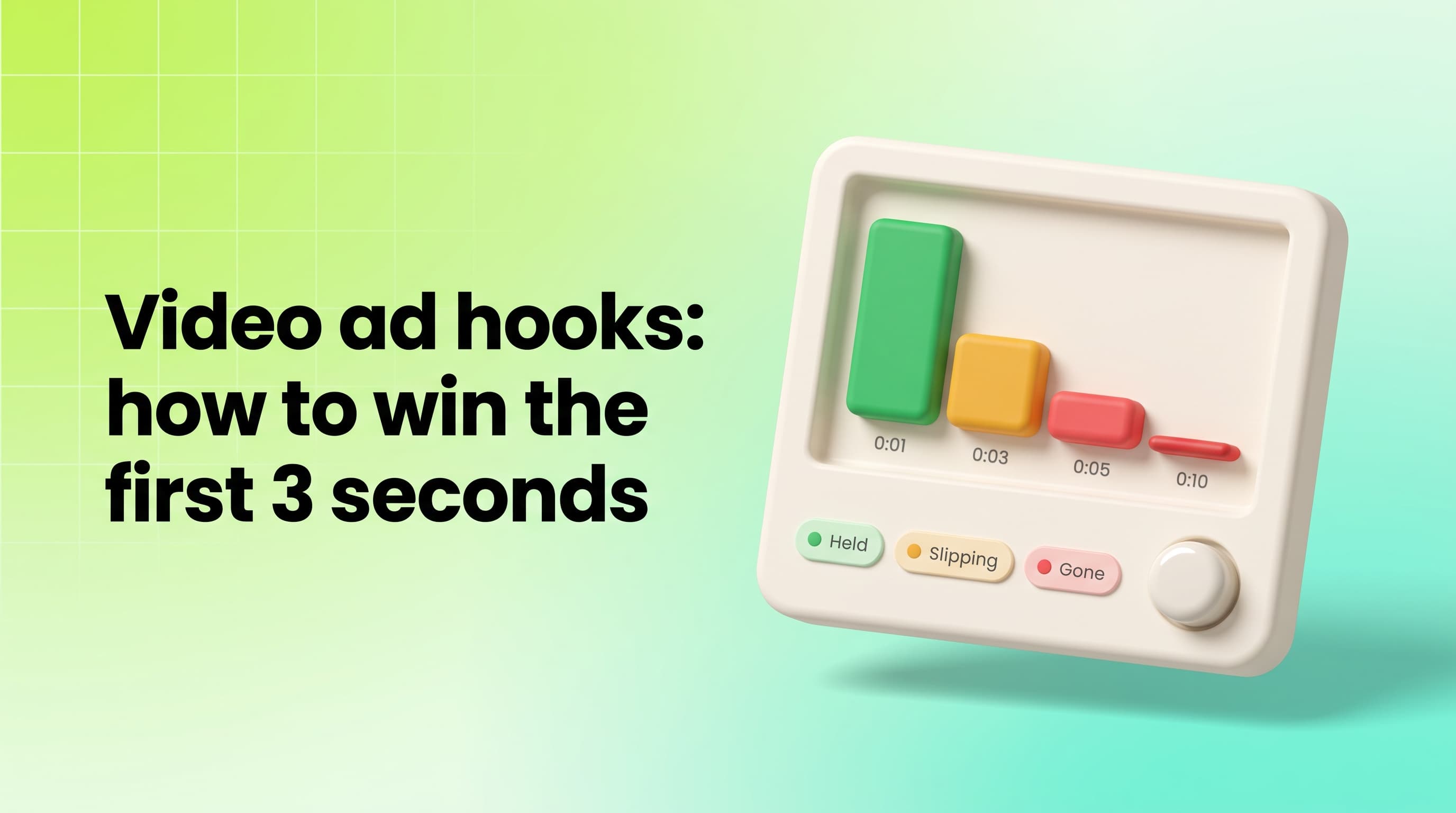
Video Ad Hooks: How to Win the First 3 Seconds
Six video ad hook mechanisms with real examples, plus the math on testing five hooks for $11.05 instead of $1,500. Buy the first three seconds, cut your CPM.
Product Photography Cost in 2026 - AI vs Studio vs Freelancer
Real 2026 pricing for product photography: studio, freelancer, and AI tools compared per image and per catalog. Find out which method fits your budget.